Ayuda y contacto
Atributos
- Peso de entrega: 0,023kg
Detalles del artículo
Hecho en USA


 (0)
(0)  Newsletters
N.º de producto: 749004994
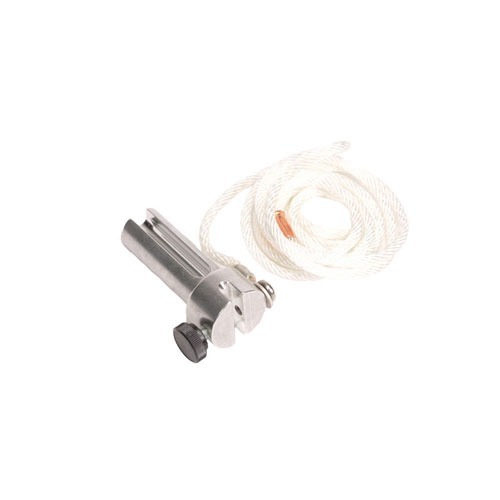
El medidor de grosor G-3 Rimfire es una herramienta muy simple y precisa diseñada para clasificar cartuchos rimfire según el grosor del reborde. Los cartuchos rimfire utilizan el reborde del casquillo para el headspace, por lo que diferentes grosores crean distintas situaciones de headspace del cartucho. La herramienta G-3 no solo te permite clasificar tu munición por el grosor del reborde, sino que también te permite medir el grosor real del reborde. Una herramienta funciona para .22 LR, .22 WMR, .17 HMR y .17 HM2. Incluye un cordón de seguridad para el cuello. La herramienta G-3 está diseñada para usarse con calibradores analógicos o digitales. Los calibradores se venden por separado.Eliminado del programa
El G-3 Rimfire Thickness Gauge es una herramienta muy simple y precisa diseñada para clasificar cartuchos rimfire según el grosor del reborde. Los cartuchos rimfire se asientan en el reborde de la carcasa, por lo que diferentes grosores crean diferentes situaciones de espacio de cabezal de cartucho.
La herramienta G-3 no solo te permite clasificar tu munición por grosor de reborde, sino que también te permite medir el grosor real del reborde. Una sola herramienta funciona para .22 LR, .22 WMR, .17 HMR y .17 HM2. Incluye una correa de seguridad para el cuello.
¡No te quedes sin el G-3 para optimizar tu experiencia de tiro!
Great accuracy investment 04/10/2012
A quick, easy way to get better accuracy out of any rimfire you own. Whether you're shooting top-of-the-line match ammo, or the "weekly special" from the hardware store, segregating your ammo by rim thickness helps to one degree or another.
One benefit is the ability to judge the consistency of your ammo. The best match ammo I've tested so far showed that rim thicknesses grouped almost 50/50 into two different thicknesses, less than .001" apart. GOOD digital calipers make it much easier to read the results, and are a good investment in themselves for many tasks.
Match ammo is very consistent, but if you shoot a 10-shot string with nine rounds of one thickness, and the other different, that 10th round will look like a flier. I used to kick myself for messing up with an occasional "bad" shot, until I started sorting the rounds by rim thickness. Many of those "fliers" went away, and not because I suddenly became a better shot.
Also, some rimfires will shoot well with almost anything, while others can be quite finicky. My CZ453 shoots almost any quality ammo well, although all brands group slightly better when sorted. My Ruger 10-22 heavy barrel wasn't that great with any sorted ammo, except ONE combination of rim thickness and bullet diameter, where it produces .600" ten-shot groups at 25 yards (my testing protocol), beaten only slightly by the CZ bolt action. Who knows what the next Ruger off the assembly line liked?
All the more reason to test your sorted ammo with every one of your rimfire weapons. I'm still testing with Federal Match, methodically eliminating variables. My first Ruger likes .0415" rim thickness, so I assembled a supply of them, along with the other thicknesses, to check out my other Rugers.
For plinking ammo, you may find a favorite weapon/ammo combo, or the most consistent brand, and get some idea of how much effort to put in the project.
For match ammo, I'm finding I need about 1000 rounds for testing in multiple rifles. About 500 rounds for the various combinations and permutations, and the other 500 to size and sort into the best performers.
This might not be everyone's cup of tea, but it's a soothing way to spend a winter evening at the work bench with some good music playing.
Hemos encontrado un error al cargar este contenido. Actualice la página para continuar. Si el problema persiste, póngase en contacto con nuestro servicio de atención al cliente.




Bienvenido a Brownells Iberica, tu destino para todo lo relacionado con armas de fuego. Con nuestras raíces en una auténtica pasión por las armas, te ofrecemos una selección inigualable de piezas de armas, accesorios para armas de fuego, herramientas de armería, miras telescópicas y puntos rojos, y conocimiento experto.
¡Ya sea que estés buscando mantener, reparar o mejorar, tenemos lo que necesitas!
Para tiradores, por tiradores
Compartimos tu entusiasmo y sabemos exactamente lo que buscas porque somos parte de la comunidad.
Selección masiva
Desde lo esencial hasta lo único, encuentra todo bajo un mismo techo.
Nuestra mezcla de tradición e innovación
Compra con la comodidad de la tecnología moderna, respaldada por una experiencia de legado.
Navega por nuestra colección y descubre por qué somos el nombre de confianza en deportes de tiro y caza.
IBERICA DE ARMERIAS S.C.C.L (F-60662343)


© 2025 Brownells Iberica
Part of the Brownells Europe Group

 Vista clásica
 Vista móvil